
A verified evidence base
- an agreed decision statement and success criteria;
- an evidence inventory and assessment of evidence quality;
- validated assumptions, risks and unresolved gaps.
Start with a Business Health Assessment. When the decision warrants deeper investigation, CENARA Discovery combines independent expertise with CENARA One to test the evidence, expose risks and establish what should happen next.
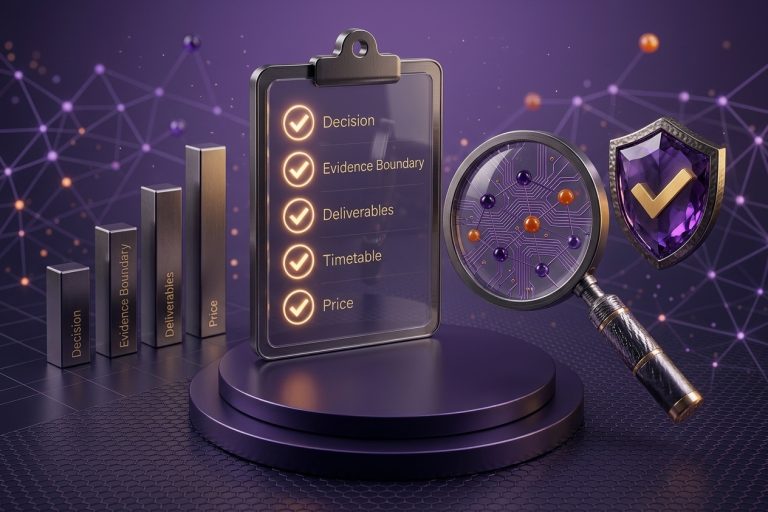
The Business Health Assessment tells you where to look. Discovery establishes what the evidence actually says. Before any paid work starts, we agree the decision, evidence boundary, deliverables, timetable, price and the specialist roles needed to deliver the work. The accepted scope becomes the governing authority for what CENARA will investigate.
CENARA Discovery Review looks across the whole decision, not just the technology. We test the business context, customer and operational reality, people and process, technology, data, governance, commercial position and readiness for change. CENARA One then shapes the investigation around the assessment, sector, jurisdiction, objectives, concerns, technology estate and agreed scope, so the team tests what is relevant rather than forcing every client through the same questionnaire.
Clarify the business outcomes, success measures, decision drivers, constraints and assumptions that the investment must support.
Understand customer journeys, demand, service performance, operating processes, roles, skills and the pain points creating cost or friction.
Map current platforms, architecture, integrations, capability gaps, constraints, technical debt and the technology evidence behind supplier claims.
Test data quality and access, AI or automation use, privacy, security, compliance obligations, governance controls and where evidence is missing or weak.
Review contracts, licensing, supplier capability, total cost, commercial dependencies, procurement constraints and whether the proposed change can create measurable value.
Turn the evidence into weighted requirements, risks, dependencies, implementation conditions, change readiness and a practical route forward.
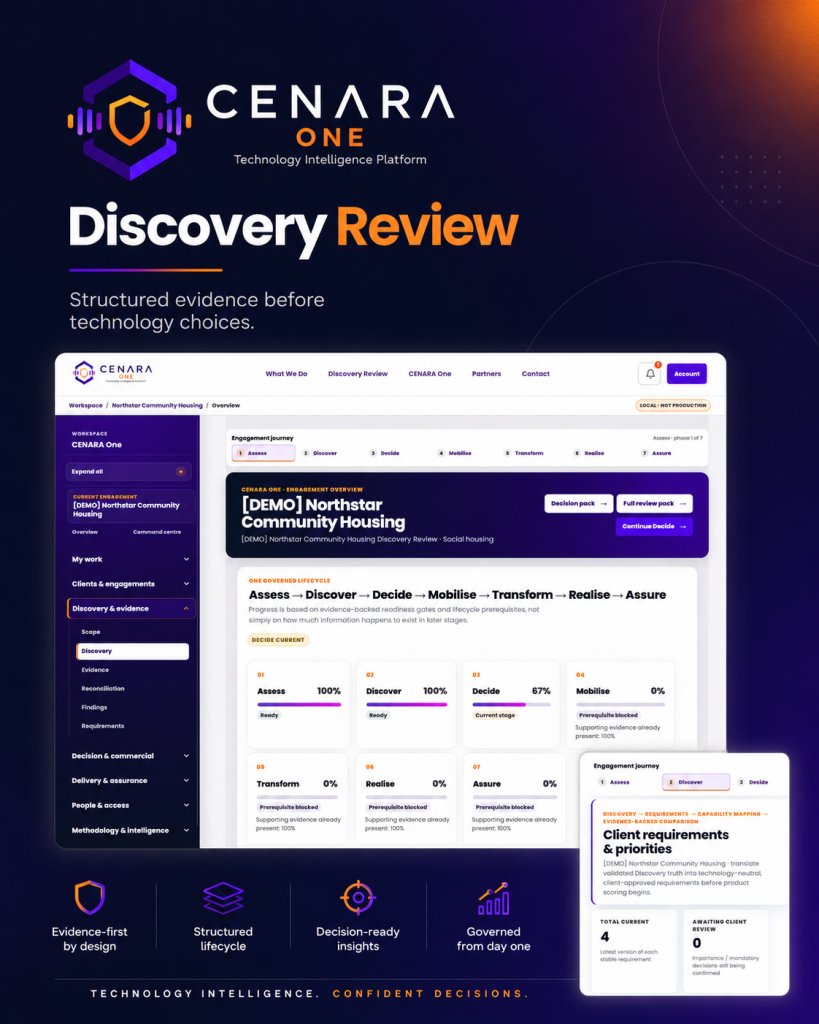
CENARA One is the decision-assurance workspace used throughout Discovery. It brings the decision, stakeholder priorities, requirements, evidence, risks, options and rationale into one structured record instead of leaving them scattered across spreadsheets, email and supplier documents.
Identify the risks and evidence gaps. Weigh what matters most. Validate claims against real evidence. Compare options consistently. Defend the final decision with a traceable record.
The result is a shared source of truth, transparent trade-offs, visible uncertainty, reusable requirements and a governance trail that remains useful after Discovery is complete. Evidence can include stakeholder interviews, documents, operating data, system configuration, technology evidence, supplier claims and governance material.
What Discovery gives you
The Business Health Assessment shows where uncertainty may sit. CENARA Discovery Review uses CENARA One and independent review to test what the evidence actually says, turn business outcomes into weighted requirements and establish whether you should optimise, change, compare products or stop before committing more money and effort.
Discovery starts with the outcome and the evidence, not with a preferred supplier or an assumption that new technology is required. The evidence may support optimisation of what you already own, process or governance change, a formal product comparison, or a decision not to proceed.
If the decision is low-risk, easily reversible, supported by strong current evidence and the organisation is already aligned on the problem and success criteria, a full Discovery Review may add more cost than value.
Discovery should be compared with the cost of making the wrong decision: replacing the wrong platform, automating a weak process, implementing before requirements are understood, discovering a compliance issue late or committing scarce internal resource to the wrong priority.
Discovery creates a controlled decision point. The evidence may show that the current platform should be retained and optimised; that business, process, data or governance work should happen first; or that a technology change is justified. Where new software is needed, the validated requirements can move into CENARA One product intelligence and decision assurance so exact products, editions, versions, deployments and regions can be compared against the same client-weighted criteria and evidence expectations. The output then supports procurement or a clean handover to your chosen delivery route.
CENARA One keeps the decision, requirements, stakeholder priorities, evidence, risks, assumptions, options and rationale connected in one structured record. It separates what someone has asserted from what the evidence supports and from the conclusion CENARA has validated. That makes the reasoning easier to challenge, approve, reuse and explain later to leadership, Risk, Procurement, Compliance or Audit.
The timetable is agreed from the scope. It depends on the breadth of the decision, evidence availability, stakeholder access and the outputs required. You will know the timetable before paid work begins.
Usually the decision sponsor and the people who hold relevant operational, technical, risk, compliance, customer or commercial evidence. We keep participation proportionate to the decision being tested.
Only material that is relevant to the decision: for example current performance data, requirements, process information, existing analysis, governance records, contracts or supplier material where applicable.
Yes. Discovery is designed to test evidence and assumptions independently, regardless of who is currently advising, supplying or implementing.
No. The evidence may support change, optimisation, a different sequence of work or no major change at all.
Yes. Discovery does not commit you to implementation with CENARA or any technology provider. The findings and decision record are intended to remain useful whether you proceed internally, use an existing partner, procure separately or decide not to proceed.
Scope, deliverables, timetable and price are agreed in writing before any paid work begins. If the evidence required changes materially, we discuss that with you before changing the scope.
The Business Health Assessment is the no-cost starting point. If it shows that important uncertainty, evidence gaps or decision risk remain, CENARA can define a CENARA Discovery Review scope before you commit to paid work. From there you can stop, optimise what you own, move into product comparison and Decision Assurance, or hand the validated requirements into your chosen procurement and delivery route.
Indicative starting point: from £7,500 + VAT.
The final fee depends on scope breadth, evidence complexity, specialist involvement, timetable and required outputs. Scope, timetable and price are agreed in writing before any paid work begins.